

What Mattered in the Macro
The compute crisis is getting into full swing. I mentioned last week that compute is still the most important factor in AI growth and this continues to accelerate.
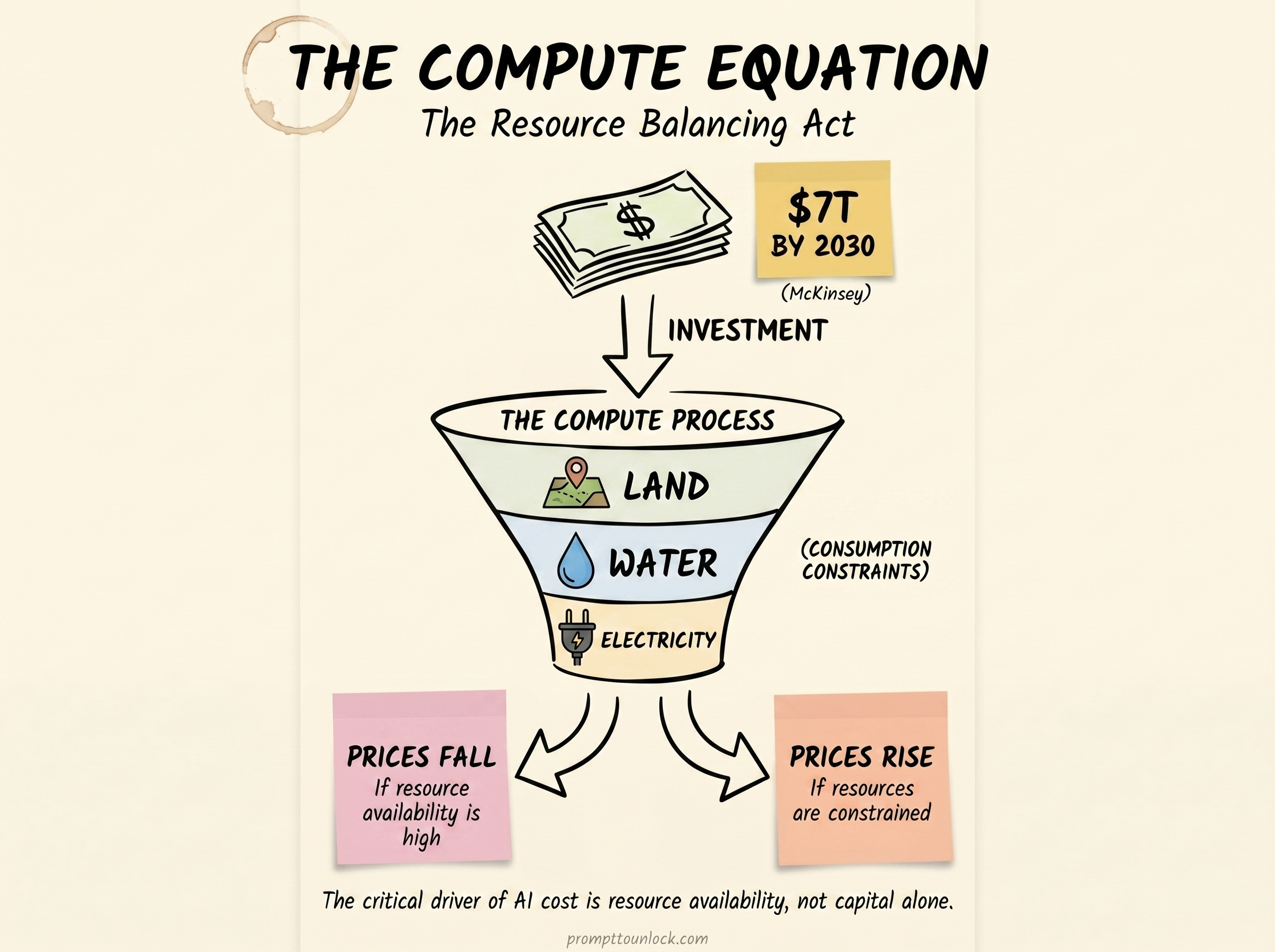
But what is compute? Compute is the processing power to run software. With AI, think of compute the way you’d think of electricity or water: a foundational utility.
And what does compute require? Land, water, and electricity.
Those are also the ‘big three’ humans need to live somewhere. So compute for AI directly competes for resources people need to live.
Think of it as old vs. new. The old system was utilities serving the people who lived near them. The new system is utilities serving compute that lives nowhere.
The bottom line is that compute access is a hard moat and directly correlated to growth and pricing for these companies. McKinsey projects $7 trillion will be spent on new compute by 2030. The deciding factor for AI growth is now a literal substation, a literal county commission vote, a literal Aboriginal-land treaty conversation.
AI political capital is becoming the new technical capital. And the tension already has a variety of symptoms:
Residential rate hikes for utilities.
Water depletion in already water scarce areas.
Political conflicts and legislation.
Sovereignty fights with Aboriginal and tribal nations.
All of which can escalate fast once the lobbying machine fires up. Federal preemption fights. State-vs-state subsidy wars. Eminent domain claims for substation siting.
The next 18-24 months of AI economics will be decided in jurisdictions most of the industry has never visited. The Compute pick below shows this playing out at opposite ends, in Utah and Australia.
Noteworthy News
Compute is becoming an increasingly geographic and political fight
Main source: multiple sources below
Two events this week showed both sides of that fight:
Box Elder County, Utah unanimously approved Stratos, which is Kevin O’Leary’s 40,000-acre AI campus that will eventually need 9 GWs. That’s more power than the entire state currently uses.
40k acres is about 62 square miles, or ~120k standard suburban homes (factoring in roads, etc.).
Estimates put water consumption anywhere from 50k gallons per day to +2 billion gallons per year. Regardless, the project is requesting 4.8 million gallons per day in water rights to cover extreme-weather scenarios.
Near Perth, Australia, the Save Mandoon Bilya coalition actively opposed a 96–120 MW facility near the Helena River, which caused the developer to withdraw the plans.
Heatmap reports that local-government opposition to data centers has now killed or stalled more proposals in 2026 than in the previous three years combined.
As of this week, data centers now consume roughly 6% of national electricity in both the US (29.2 GW) and UK (5.8%) per the IDCA’s 2026 Global Data Centre Report. That’s widely predicted to increase to at least 12% by 2030.
My key takeaway:
Every AI company pitch the last 3 years has operated under the assumption that inference costs will continue to decline in a Moore’s law style curve. But this competition with local governments may put a floor under it.
So every user of AI will depend on cheap inference at scale to keep prices reasonable. If that doesn’t happen… you should:
Bet on distributed and on-device compute as immensely more valuable.
If you’re not experimenting with local models, do it now.
Treat any business model that needs 10x inference scaling for unit economics as a risky bet, not a verified plan.
Recognize that “AI gets cheaper every year” was a load-bearing assumption that may rapidly collapse.
You should start watching local-government decisions in their primary cloud region the way you watch chip yields.
Sources to read yourself:
https://eandt.theiet.org/2026/05/15/uk-and-us-data-centres-now-consume-around-6-national-electricity
https://www.mckinsey.com/industries/technology-media-and-telecommunications/our-insights/the-cost-of-compute-a-7-trillion-dollar-race-to-scale-data-centers
https://www.techradar.com/pro/utah-just-approved-a-data-center-twice-the-size-of-manhattan-that-will-consume-more-electricity-than-the-entire-state
https://geographical.co.uk/news/utah-approves-construction-of-data-centre-twice-as-large-as-manhattan
https://www.theguardian.com/technology/2026/may/15/developer-withdraws-plans-for-perth-datacentre-after-fierce-community-opposition
https://heatmap.news/politics/local-opposition-data-center-cancellations
Anthropic just made software a second-class citizen
Main source: Anthropic news (May 2026)
Anthropic launched Claude for Small Business with 15 agentic workflows wired across QuickBooks, PayPal, HubSpot, Canva, DocuSign, Google Workspace, Microsoft 365, and Slack. This was at no additional charge beyond existing Claude and partner licenses.
Sources to read yourself:
https://qz.com/anthropic-claude-small-business-quickbooks-paypal-051326
https://www.axios.com/2026/05/13/anthropic-claude-small-business-smb
https://openai.com/index/openai-launches-the-deployment-company/
https://stratechery.com/2026/the-deployment-company-back-to-the-70s-apple-and-intel/
https://www.infoq.com/news/2026/05/anthropic-claude-code-auto-mode/
https://www.geeky-gadgets.com/gemini-workspace-intelligence-features/
My key takeaway:
Two things worth noting.
First, this is more evidence that software isn’t dead, but we’re shifting how we use it. I.e., the modularization of outcomes.
Second, most products will stop being judged primarily by what a human can do inside them. They’ll be judged by how well an agent can stitch together discrete outcomes.
This is a radical shift from “is this UI intuitive?” or what some would call the “dashboardification of software”… to “can an agent use this at 3am while my customer sleeps?”
So any software that can only be operated by a human is on borrowed time (maybe 3-5 years?). Agents are now your primary user class and they’ll interact with your product 20x more than any human.
This is a product category that will continue to grow rapidly over the next few years and it’s the structural transition. And anytime there is a structural transition in any market, there is opportunity.
Example of usage:
Judge Rakoff: your AI chatbot logs are not privileged
Main source: United States v. Heppner (Harvard Law Review)
This was massive.
Background: Bradley Heppner, former chairman of GWG Holdings, was indicted on federal securities and wire fraud charges. During his arrest, the FBI seized documents that Heppner generated by inputting case facts and asking Claude for legal strategy and defense advice.
Instead of suppressing this evidence, SDNY Judge Jed Rakoff issued a first-of-its-kind written opinion holding that prompts and outputs created by a criminal defendant using a public version of Claude were neither attorney-client privileged nor protected as work product. Even though the defendant was synthesizing his lawyers’ input and forwarded the documents to counsel.
Work product doctrine is a legal rule that protects documents, notes, and tangible materials prepared by or for an attorney in anticipation of litigation
The three-pronged reasoning from Judge Rakoff:
An AI tool is not a lawyer.
The platform’s privacy policy disclaims confidentiality (training and third-party disclosure).
The defendant wasn’t communicating with the tool to obtain legal advice.
Essentially, this means that anything you enter into an AI tool that meets the above criteria, is discoverable in a court case.
Sources to read yourself:
My key takeaway:
This will almost certainly extend to company/enterprise compliance, deal work, or any sensitive/confidential information put into any consumer AI product.
For my money, there is only one solution worth discussing.
Opt-out of any setting that allows them to reuse your data for training or any secondary use. This removes your data from any training pipeline and limits retention.
As an example, this is Claude’s setting:

This is Gemini’s setting:
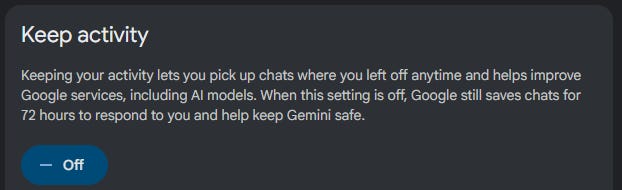
Side note: you may opt into longer data retention if you give specific responses or chats a thumbs up/down (this is a universal feedback feature for most products).
I would also refrain from putting anything into any of these AI tools that you wouldn’t want anyone to see.
Legit Learnings
This week’s three Learnings are all about one thing: the Claude Code update this month that introduced a command called /goal.
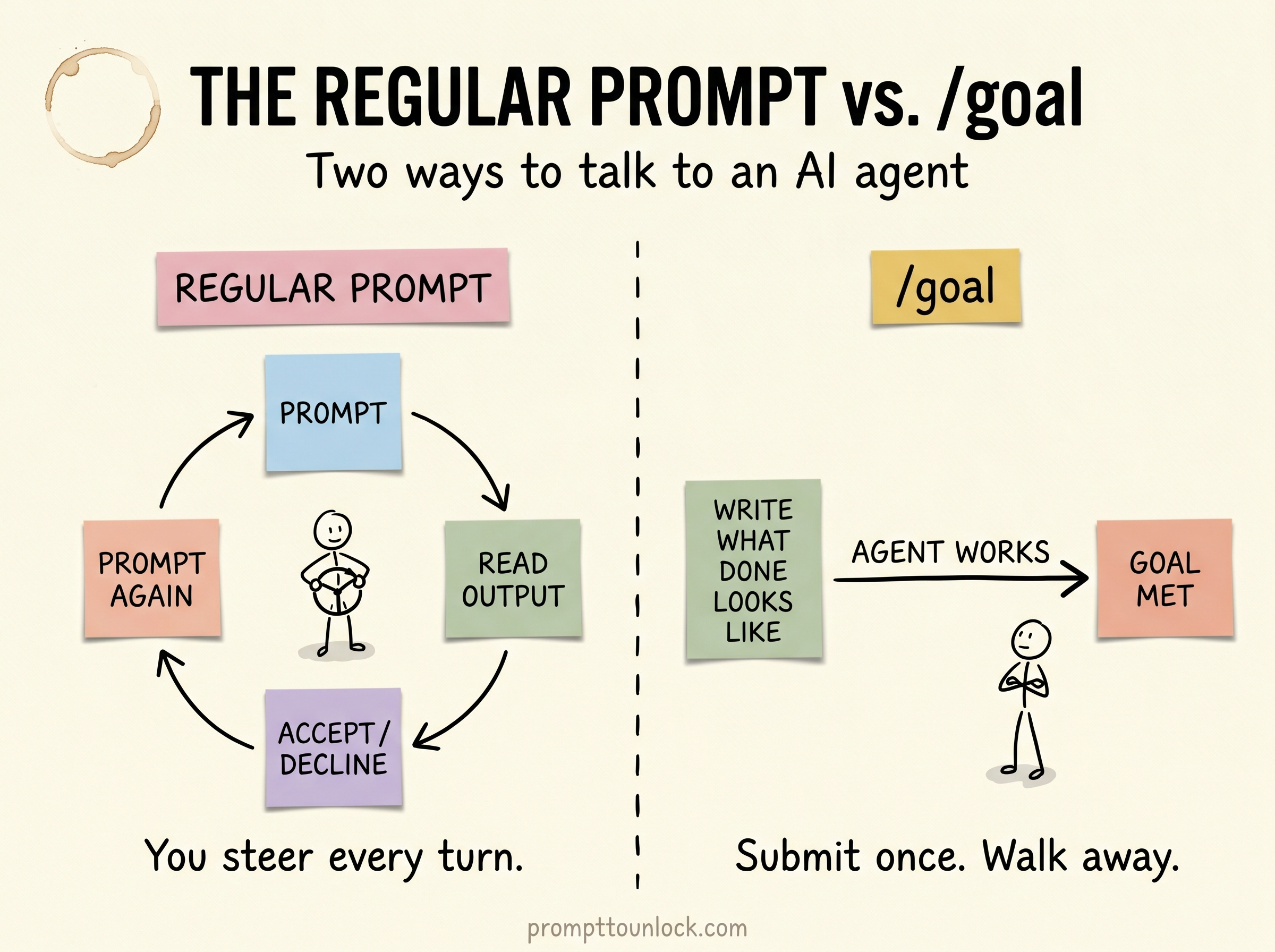
A regular prompt gets you the next response. You’re usually operating in the same loop: prompt → read output → accept/decline it → prompt again. You’re steering every turn.
/goal hands the wheel to the agent. You write what done looks like, submit it once, and the agent works toward it until it gets there or runs out of budget.
What you need to know:
Tracks elapsed time, turns, and token usage as it runs. Can run for hours.
Best for: scoped tasks with a measurable done-state (tests passing, lint clean, audit clean).
Not for: open-ended creative work, unfamiliar codebases, anything where you want to approve each step.
Best-practice prompt structure: scope + constraints + done condition.
Most coverage is treating this as a developer-only feature (level 4 builders and above). But the underlying principles aren’t only for builders.
Confused on the levels? Read about them here.
For L0–1: Tell AI where to end up, not how to get there
This prompting upgrade that makes every other prompting tip work better.
Most casual AI users push vague prompts in disconnected steps. “Write an email.” Then “make it more formal.” Then “add a CTA.” Again, you’re steering here.
The /goal pattern flips this: describe what done looks like, then let the AI figure out how to get there. You don’t need Claude Code to use this.
My key takeaway: On your next few prompts, try this: before any AI prompt longer than a sentence, complete the phrase “I’ll know this is done when…”
The skill is learning to describe DONE before you describe the WORK. You’ll be manually doing what /goal does autonomously, but scaled down to your level. This will prepare you to move into being a practitioner.
For L2–3: Completion conditions are the new prompt
You already prompt with structure: personas, constraints, examples, etc. But /goal formalizes the next layer, completion criteria.
And you can start adding it today, with or without Claude Code.
The unlock here isn’t the prompt syntax. It’s the discipline of stating a completion condition once and letting the AI run the iteration loop YOU normally run yourself.
Three components separate goals that work from goals that drift:
Scope. What inputs, files, or surfaces are in play.
Constraints. What’s off-limits.
Done condition. What’s measurably true when the work is complete.
If you can phrase a request in those three terms, you've removed yourself as the loop runner. This works in any AI chat (ChatGPT, Claude, Gemini, Copilot). The slash command is Claude Code's syntax for the same pattern.
My key takeaway: Pick one multi-step workflow you currently run step by step and rewrite it as a goal prompt. Here's the template, filled in for a resume rewrite (the most universal example I can think of). Copy it. Swap in your details. Drop it into any AI chat.
GOAL: Rewrite my resume into a one-page version tailored for [target role at target company] that earns a 30-second read from the hiring manager.

— CONTEXT —
· Current role: [your title, company, years]
· Target role: [job title + company + link to JD if you have it]
· Years of relevant experience: [#]
· Top 3 wins worth leading with: [metric 1, metric 2, metric 3]
· Existing materials: [paste current resume below; add LinkedIn URL if relevant]
· Off-limits: [anything I will not lie about, inflate, or omit]

— SUCCESS CRITERIA (ALL MUST BE TRUE) —
1. Fits on one page in standard formatting.
2. Every bullet includes a quantified result (number, %, $, or time saved).
3. Top three bullets map directly to keywords in the job description.
4. No clichés ("results-driven," "team player," "passionate about").
5. No unexplained gaps over three months.
6. Reads like the candidate the JD describes, not a generic candidate.

— OPERATING RULES —
1. PLAN FIRST. Output your tailoring strategy before rewriting.
2. WORK AUTONOMOUSLY. Don't ask clarifying questions unless something genuinely critical is missing.
3. SELF-CHECK. After drafting, re-read against every success criterion one by one.
4. NO PLACEHOLDERS. No "[insert metric]" or "[your achievement here]" bullets. If you don't have a number, ask me once, then keep moving.
5. FIX YOURSELF. If a bullet fails a criterion, rewrite it. Don't hand me a list of "things to fix."
6. STAY ON GOAL. If you spot LinkedIn or cover-letter improvements, note them at the end. Don't pivot mid-task.

— FINAL DELIVERABLE —
✅ Confirmation each success criterion is satisfied.
📄 The rewritten resume, ready to copy-paste.
📝 What you cut, what you kept, and why.
⚠️ Any claim I should double-check before sending.

Begin by outputting your tailoring strategy. Then execute the rewrite end-to-end without checking in unless genuinely blocked.
The first time you use a structure like this, you'll spend ten minutes scoping. By the third use, you'll have a template that runs in two minutes and produces output you might have previously spent an hour iterating toward.
For L4–5: Your agent harness just shrank to /goal. But it's not a contract yet.
You’re not trying to mimic /goal anymore. You’re actually using it. Three implications worth chewing on this week:
Simplifying your agent harness. /goal is a turnkey feature for autonomous agents. What can it replace in your stack?
Token management. A long
/goalrun can burn hours and 100K+ tokens. Where are the sharp edges?Evaluating the output. The current default evaluator in Claude Code is Haiku. Codex requires your own eval suite. How are you going to guarantee return-on-investment when using /goal?
My key takeaway: 1 & 2 above are highly dependent on your individual stack. But 3 is something everyone, everywhere needs to consider.
Any evaluator is an upgrade over single-agent self-grading. But what does the evaluator judge? Per Claude Code docs, “It doesn’t run commands or read files independently, so write the condition as something Claude’s own output can demonstrate.”
So it doesn’t independently open the file system, run the tests, or check external state. If the worker hallucinates a passing test result, the judge accepts it on faith.
How many times have you seen a model be 99% confident but wrong?
For a production contract, you need a third party. Someone who walks into the room with their own tools, runs the tests themselves, and judges the work without trusting the worker’s report blindly.
Here are some moves to fix this, ranked by lift.
Pattern A: Run the success criteria as a separate /goal with a clean session. Each /goal invocation starts fresh, so the evaluator can’t be poisoned by the worker’s claims. Something like:
/goal Verify that all six success criteria from the previous run are
currently TRUE in the working tree. Run each test independently with
your own commands. Report pass/fail per criterion with command output
as proof. Do not trust any prior transcript or claim.
Pattern B: If using Claude Code, use the open-source eval tooling. The bkper/claude-eval project ships an LLM-as-judge harness for Claude Code with binary PASS/FAIL outputs per criterion. Drop your success criteria into the config, point it at the working tree, get a structured verdict.
Pattern C: Use a different model as the judge. GPT evaluating Claude’s work, or Gemini evaluating either. Anthropic’s own eval guidance recommends manually scoring 20–30 cases first; aim for 80%+ agreement between your judge model and a human reviewer before you trust the judge at scale.
The principle: an agent that grades its own work is performative. You need an independent model for real results.
Skip this
The “one-person billion-dollar company by 2026” discourse multiple X / Substack threads, week of May 11–17, 2026
Dario Amodei’s “70–80% probability of a one-person billion-dollar company in 2026” framing is recirculating heavily this week, sitting on top of Pieter Levels and Marc Lou’s solo-founder content. FutureDigest even ran a “no longer a prediction. It happened.” post this week to fuel it.
Skip all of it. The number isn’t falsifiable, the framing is engineered to feel inevitable, and most of the people writing about it monetize the prediction. None of it changes what you do at your desk on Monday morning.
Plus, the actual cost-collapse story underneath all this, that one operator can now do the work of a 2019 ten-person team, is real, important, and buried under the cult content. If anyone wants to write the real version of that piece, OpenAI’s B2B Signals data is a better starting point than Amodei’s vibes.
What I cut
A few things that almost made the lineup:
Anthropic + Gates Foundation $200M partnership: real and good, but a generic corporate press release by this issue’s filter. It doesn’t redraw a single operational boundary this week.
Google’s first AI-developed zero-day disclosure (Google Threat Intelligence Group): new risk category, but the Rakoff ruling carries more immediate operational consequence for the average reader.
—-
Do you think that we have a compute shortage in the near future? And do think that pops the ‘AI bubble’ people think we’re in? Hit reply. I read every response.